
PASSIVE FIRE PROTECTION SYSTEMS & FIRE COMPARTMENTATION
OF BUILDINGS
Passive fire protection is the most fundamental layer of a building’s safety strategy in the event of a fire.
It is designed to perform continuously and reliably, without human intervention, ensuring that fire, smoke, and heat are effectively contained and prevented from spreading uncontrollably.
The modern regulatory framework (EN 13501-2, EN 1366-3, EN 1634-1 and Presidential Decree 41/2018) makes fire compartmentation mandatory across a wide range of building types and applications.
The purpose of this page is to provide clear, technically substantiated information on passive fire protection and fire compartmentation, enabling engineers, contractors, and building owners to fully understand the applicable requirements, design principles, and best practices for correct implementation.

What Is Passive Fire Protection
Passive fire protection refers to a set of built-in fire safety measures designed to:
-
restrict fire propagation
-
reduce heat transmission
-
control smoke spread
-
safeguard load-bearing structures, evacuation routes, and high-risk zones
In contrast to active fire protection, passive systems function continuously and independently, without the need for detection, power supply, or manual activation. They are an inherent part of the building and represent the core of its fire protection concept.

What Is Fire Compartmentation
Fire compartmentation is the division of a building into fire-resistant compartments designed to withstand fire for a specified EI rating (30, 60, 90, 120 minutes, etc.), in accordance with:
-
EN 13501-2 (fire resistance classification)
-
EN 1991-1-2 (Eurocode – actions on structures exposed to fire)
-
Presidential Decree 41/2018 (Greek fire safety regulations)
Each fire compartment functions as an independent, fire-protected zone that must maintain its fire resistance for the required period in order to:
-
allow safe evacuation
-
prevent the collapse of critical building elements
-
limit the spread of fire
-
protect adjacent areas and properties
To achieve this, a fire compartment must incorporate:
-
EI-rated walls and partitions
-
fire-rated doors with self-closing mechanisms
-
fire-rated glazed systems
-
firestopping of MEP penetrations (EN 1366-3)
-
fire-rated windows, shutters, or fire curtains where required
Fire Resistance Classification Criteria (EN 13501-2)
Οι Δείκτες Ταξινόμησης Πυραντίστασης (EN 13501-2)

The element maintains its integrity by preventing the passage of flames and hot gases to the non-fire-exposed side.
E — Integrity
The element limits the temperature increase on the non-fire-exposed side to within acceptable thresholds.
I — Insulation
The element limits thermal radiation that could cause ignition of adjacent materials.
W — Radiation
t is used in combination with integrity and insulation in REI classifications.
R — Loadbearing Capacity
It evaluates the capability of an element—primarily doors—to limit smoke leakage.
S — Smoke Control
Common EI Fire Resistance Ratings by Occupancy Type
-
EI30
Typically required in residential buildings and low-risk office spaces. -
EI60
A standard requirement for hotels, retail units, food & beverage areas, and small commercial occupancies. -
EI90
Commonly applied in assembly areas, buildings with high occupant loads, or critical fire compartmentation zones. -
EI120
A typical requirement for industrial facilities, warehouses, logistics centers, and areas with increased fire load. -
EI180 – EI240
Applicable to special-purpose or high-risk installations, such as energy facilities, electrical substations, data centers, tunnels, or strategic infrastructure.
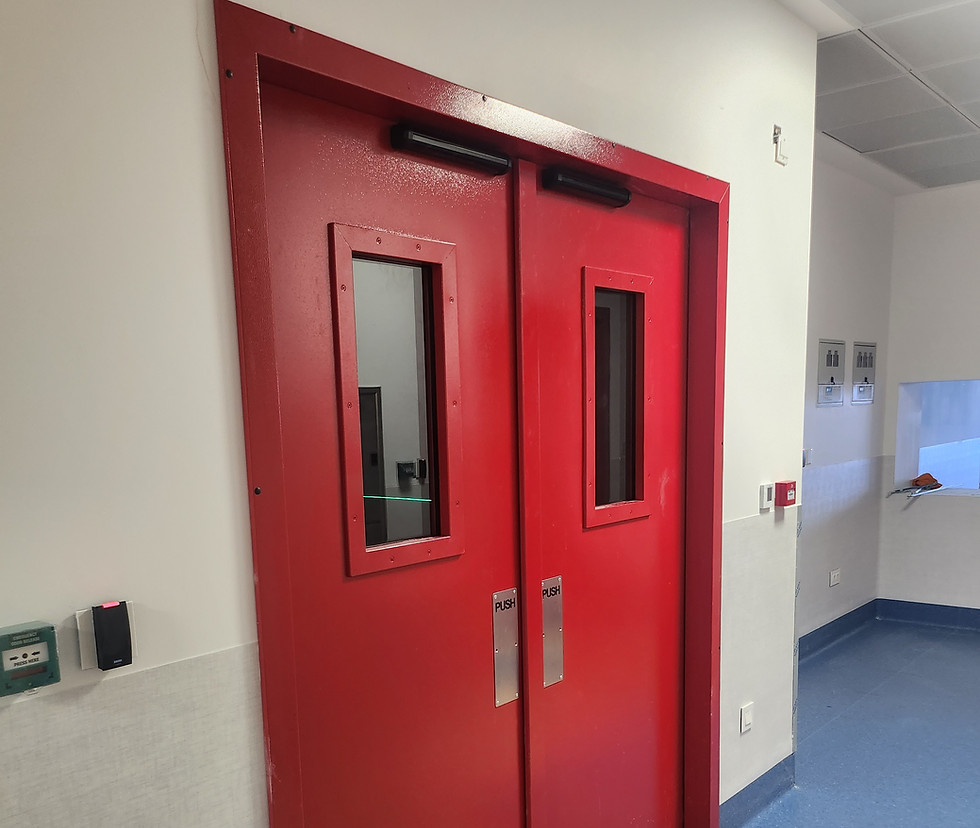
Technical & Regulatory Requirements
Fire-rated doors are the most critical movable element within a fire compartment.
To be considered compliant and effective, they must:
-
be certified in accordance with EN 16034
-
be tested to EN 1634-1
-
bear CE marking
-
be accompanied by a Declaration of Performance (DoP)
-
be equipped with a self-closing mechanism

Mandatory Self-Closing Function
Mandatory Self-Closing Function
The self-closing function is an integral part of fire door certification and a non-negotiable requirement.
According to Presidential Decree 41/2018, EN 16034, EN 1154 and EN 1634-1:
-
The door must close automatically after every opening.
-
Keeping the door open using wedges or other objects is strictly prohibited.
-
The door may remain open only when held by an electromagnetic hold-open device connected to the fire detection system.
-
If the door closer is removed or replaced with a non-compatible component, the door loses its EI fire resistance classification.
What the Engineer Must Check on a Fire-Rated Door
-
CE marking in accordance with EN 16034
(currently mandatory only for fire-rated external doors) -
Product identification plate / label
-
Declaration of Performance (DoP) and application of EXAP, where required
-
Certified hardware, compatible with the fire resistance test, including:
-
Door closer in accordance with EN 1154
-
Intumescent seals
-
Hinges and lock cases
-
Emergency exit devices / panic hardware in accordance with EN 1125 / EN 179
-
-
Compliance with the permitted installation tolerances, as defined in the fire test report and the manufacturer’s installation instructions
-
Absence of any unauthorised modifications to the door leaf, frame, or hardware

Any penetration of pipes, cables, or mixed MEP services through a fire-separating element (wall or slab) compromises the fire compartment and must be properly reinstated using a certified firestopping system, in order to maintain the required fire resistance of the building element.
The selection of the appropriate firestopping solution depends on:
-
the type of penetration
-
the material of the services
-
the diameter or opening size
-
the required fire resistance rating (EI)

Typical Firestopping Applications
-
Plastic pipes
➜ Intumescent collars and intumescent wraps / bands -
Metal pipes
➜ Thermal insulation materials (e.g. mineral wool) combined with certified fire-protective coatings or sealants -
Cable penetrations
➜ Fire-rated sealants, fire-resistant boards, or removable firestop pillows -
Mixed penetrations (pipes & cables)
➜ Combined firestopping systems using fire-resistant boards, sealants, and intumescent collars, in accordance with the certified application details
Technical Requirements for Firestopping Systems
Each firestopping system for service penetrations must be supported by:
-
a fire resistance test report in accordance with EN 1366-3
(Fire resistance tests for service installations) -
EXAP (Extended Application) documentation
to define permitted application variations (dimensions, types of penetrations, etc.) -
a fire resistance classification in accordance with EN 13501-2
(e.g. EI 60, EI 90, EI 120)
Why Choose ZNB Systems
ZNB Systems specializes exclusively in passive fire protection solutions, delivering a fully integrated technical approach from design and specification through to on-site implementation.
-
Specialized passive fire protection solutions for projects of any scale
-
Full compliance with European regulations and EN standards
-
Certified products and professional installation, strictly in accordance with fire test reports and manufacturers’ instructions
-
Technical support and guidance for designers, supervising engineers, and contractors
-
Complete technical documentation for Fire Authority submissions and project inspections


Request Technical Support or a Quotation
Get in touch with our team for project-specific technical support or a tailored quotation.
You can also download the Complete Passive Fire Protection Technical Guide, covering fire compartmentation, fire-rated doors, and firestopping solutions in line with applicable European standards.